
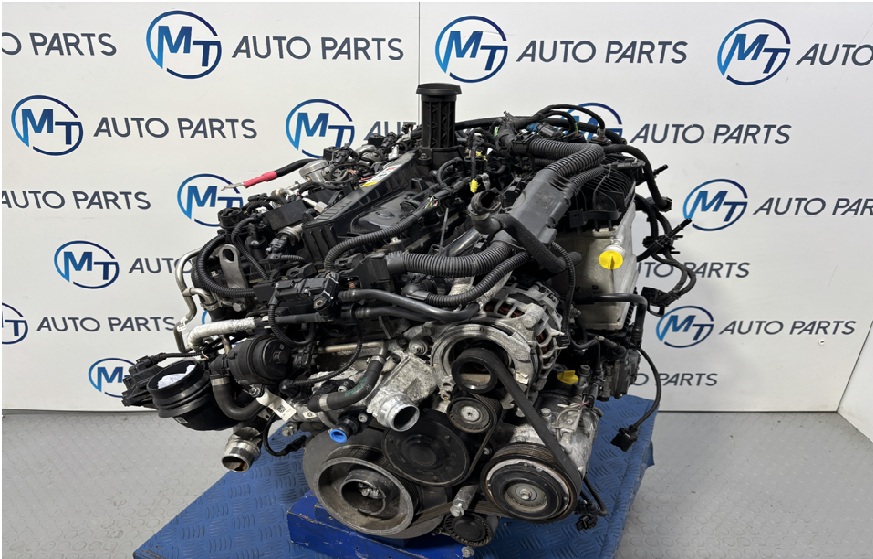
It depends on what you want from your BMW. If you’re after precision and sharp handling on track days, the S58 is hard to beat. But if you prefer big torque, a proper V8 soundtrack and the sort of performance you can feel in your chest, the S63 has a character of its own. Neither is better in every way.
Both are among BMW M’s standout engines, but they deliver performance very differently. The S58 is a twin-turbocharged straight-six, while the S63 is a twin-turbocharged V8. One feels sharp and controlled; the other delivers a more muscular, effortless surge of power.
So, which one suits you best? Let’s take a closer look at how they compare.
At a Glance – The Key Numbers
The S58 is the 3.0-litre straight-six found in BMW’s newer M cars. It first appeared in the X3 M and X4 M in 2019, producing 473 hp and 550 Nm in standard form. In the M3 and M4 Competition, that rises to 503 hp and 650 Nm. It’ll rev to 7,200 rpm and has since made its way into the M2 as well.
The S63 has been around longer. BMW introduced this 4.4-litre twin-turbo V8 in the X5 M in 2009, and it went on to power the M5, M8, X5 M and X6 M. In its later version, it produces 591 hp, or 617 hp in Competition trim. Torque varies between models, reaching 750 Nm in some applications.
Read More: What’s New in the 2024 Models of Toyota?
There are differences in the engineering, too. Both engines use Double VANOS and Valvetronic systems, but their intercoolers are arranged very differently. The S58’s is built into the intake plenum, while the S63’s sits between the cylinder banks. The figures tell part of the story, but the real difference is how BMW has designed each engine to suit the car it powers.
The BMW S58 Engine – What Makes It Special
Architecture and construction
The S58B30A is based on BMW’s B58 straight-six, but BMW M made several important changes to handle higher power. It uses a closed-deck aluminium block for extra strength, along with a forged crankshaft, connecting rods and aluminium pistons. Its 9.3:1 compression ratio also suits the big boost levels the engine runs.
Unlike the standard B58, the S58 uses two mono-scroll turbochargers. A water-to-air intercooler sits inside the intake plenum, helping keep intake temperatures down. The fuel system runs at up to 350 bar, and models produced from 2022 onwards also gained port injection alongside direct injection.
Power outputs – standard and competition
The standard S58 produces 473 hp and 550 Nm of torque. In M3 and M4 Competition models, output rises to 503 hp and 650 Nm. The M3 CS and M4 CS produce 543 hp, while the limited-run 3.0 CSL reaches 552 hp. All use the same 2,993 cc engine, with a redline of 7,200 rpm.
Which cars use the S58?
The S58 first appeared in the BMW X3 M and X4 M in 2019. It later found its way into the G80 M3, G82 M4 and G87 M2, as well as the Alpina B3. It gives BMW M strong performance from a 3.0-litre engine, without the extra size and weight of a V8.
The S63 Engine – The V8 That Refuses to Go Quietly
The S63 is BMW M’s 4.4-litre twin-turbo V8. Its defining feature is the hot-vee layout, with both turbochargers sitting between the cylinder banks rather than on the outside of the engine. This keeps the exhaust gases close to the turbos, helping them spool up quickly and improving throttle response.
The downside is heat. With the turbos sitting in the middle of the engine, managing temperatures becomes more difficult. BMW uses water-to-air intercooling and revised cooling systems to keep things under control.
The engine has a 90-degree V8 layout, with an 89 mm bore and 88.3 mm stroke. Early versions lacked Valvetronic, but BMW added it with the 2012 Technical Update (TU). The S63 also uses twin-scroll turbochargers and a specially designed exhaust manifold to improve efficiency and deliver power across a wide rev range.
S63 variants – from S63B44O0 to S63B44T4
The S63 engine has been revised several times since its introduction. Each version brings changes to performance, cooling and engine management, so knowing which variant a car uses is important when comparing specifications or sourcing replacement parts.
S63B44O0 (2009–2012): The original engine, producing 547 hp and 680 Nm. This is the version that attracted the most reliability criticism. The rod bearings in early cars were prone to failure, particularly where oil change intervals were extended or oil quality was poor. BMW revised the rod design in later production with additional drain holes to improve lubrication. If you’re looking at a first-generation X5 M or X6 M from this era, the maintenance history matters more than almost anything else.
S63B44T0 (2011–2018): The first TU revision. Compression raised to 10.1:1, Valvetronic added, revised turbos, lighter pistons, forged connecting rods and crankshaft. More reliable than the O0, and this is the engine found in the F10 M5, F12/F13 M6, and first-generation F15 X5 M.
S63B44T2 (2015–2018): Second revision, producing 567 hp and 750 Nm. Twin-scroll turbos adopted, wider power band. Found in the M5 Competition and late-run M6 Competition.
S63B44T4 (2018–present): The current generation, producing 591 hp in standard form and 617 hp in Competition specification. This is the engine in the F90 M5, F91/F92/F93 M8, F95 X5 M, and F96 X6 M. Improved thermal shielding, revised intake manifold, and higher-pressure injection. The most powerful and, by most accounts, the most refined iteration of the S63.
How They Drive, and Why That Difference Matters
The S58: precision, linearity, response
The BMW S58 engine’s defining characteristic is how linear it feels. Unlike many turbocharged engines that deliver their torque in a rush from a specific rpm and then plateau, the S58 builds progressively and keeps pulling through to its 7,200 rpm redline with genuine enthusiasm. The twin mono-scroll setup, the water-to-air intercooler mounted close to the engine, and the high-pressure fuel system all contribute to a throttle response that feels closer to a naturally aspirated engine than any turbocharged unit has a right to.
Read More: 2024 Chevrolet Bolt EUV Specs, Features, and More
In the G80 M3 and G82 M4, this translates to a car that rewards driver input precisely. The power goes where you point it, with no lag to manage, no moment of delay between your right foot and the front of the torque curve. On a track, this is enormously useful. On a wet B-road, it’s the difference between confidence and anxiety.
The sound is good, a hard, metallic six-cylinder rasp, particularly from the CS and CSL cars. But it’s honest rather than theatrical. The S58 engine is not trying to perform. It’s trying to be fast.
The S63: torque, theatre, the V8 experience
The S63 offers something the S58 simply cannot: 4.4 litres of V8 and the character that comes with it. The torque arrives earlier and builds with more authority, 750 Nm from the T2 onwards, available in a broader band than the inline-six. In the M5 and M8, this means the kind of mid-range punch that flattens you into the seat on a motorway overtake without needing to be anywhere near the rev limit.
The hot-vee architecture means the S63 spools quickly for a V8 of this displacement, the turbo response is sharper than the older V8s BMW used, and the pulse-tuned manifold broadens the power delivery in ways that make it feel responsive even at low revs. When the engine is fully wound up, the sound, that deep, layered V8 note, particularly on the M5 or X5 M with the sports exhaust open, is something the inline-six generations of BMW M cars have never quite replicated.
The S63 is also the heavier of the two engines by a significant margin, being a V8 of substantially larger displacement. In the M5 and M8, BMW manages this through chassis tuning and the four-wheel-drive system, but it means the cars built around the S63 feel fundamentally different from a G80 M3. Bigger, more planted, more muscular, and deliberately so.
Reliability & What You Need to Know Before Buying
S58 reliability
The S58 has a good reputation so far, although it’s still too early to judge its long-term reliability. BMW built on the experience gained from the S55 and B58, making changes to the block, internal components and fuel system.
There have been reports of crank reluctor wheel wear, oil cooler leaks and high-pressure fuel pump issues. Carbon buildup can also affect earlier direct-injection versions, although BMW added port injection to newer models from 2022 onwards.
Regular servicing is important, particularly if the car has seen track use or engine tuning. Check the service history carefully and look for signs of leaks or previous repairs. A well-maintained S58 should be capable of handling high mileage, but its long-term track record is still developing.
S63 reliability
The S63 has been around much longer, and its reliability depends heavily on which version you’re buying. Early engines had problems with connecting rod bearings, prompting BMW to revise the design to improve lubrication. Later versions benefited from further updates, so it’s important not to treat every S63 as the same engine.
Oil consumption is another concern. The hot-vee layout puts the turbochargers in a very hot environment, and worn seals can lead to increased oil use. Before buying, check how often the owner has needed to top up the oil and look for signs of turbocharger wear.
VANOS solenoids, spark plugs and ignition coils can also need attention as the mileage increases. These are worth checking during a pre-purchase inspection, particularly on cars that have been driven hard or modified.
The later S63B44T4, fitted to models such as the F90 M5 and F95 X5 M, benefits from years of development. However, these engines are still complex, high-performance units, and repairs can be expensive. A full service history and an inspection by a BMW specialist are well worth the investment.
Tuning Potential
The S58: plenty of room for more power
The S58 responds well to tuning. With an ECU remap and the right supporting modifications, outputs of around 570–620 hp are achievable on standard turbos. Add E85 fuel and further upgrades, and some builds reach 680–730 hp without changing the turbos.
There’s more to come with upgraded turbos and fuelling. Builds producing over 800 hp have been demonstrated, with some going considerably further. However, these figures require substantial investment and put more strain on the engine and drivetrain.
For a road car that still needs to be reliable, around 650–700 hp is a more sensible target with the necessary supporting modifications. Beyond that, strengthening internal components and upgrading other parts of the drivetrain become increasingly important.
The S63: proven tuning options
The S63 has been around longer, so there’s a well-established aftermarket and plenty of experience to draw on. An ECU remap and downpipes can deliver a noticeable power increase, while more extensive modifications and E85 fuel can push output much further. Some builds exceed 700 hp at the wheels on standard turbos.
The gearbox also needs consideration as power rises. More torque puts additional strain on the transmission, particularly in cars driven hard or used for repeated launches. At higher power levels, upgraded clutch packs and other supporting modifications may be needed.
The main advantage of the S63 is that its tuning potential is well documented. There’s a wide choice of proven upgrades, and experienced specialists have a clearer understanding of what works. The S58 is catching up quickly, but the S63 still benefits from years of development and real-world experience.
Parts Availability for Used Cars
Both engines are represented in the used market. The S63-powered F10 M5 and F15 X5 M in particular are now widely available at prices that make performance car ownership more accessible. As these cars age and reach end-of-life, dismantled genuine second-hand parts and used BMW engines become an important source for owners keeping them on the road.
Used genuine BMW engine components for S63 and S58-powered models, including ancillaries, sensors, cooling components and supporting hardware, are available through specialist dismantlers. MT Auto Parts, a BMW specialist based in South Yorkshire, stocks used genuine parts from F, G and U generation BMW models, with each component listed with mileage and condition details so you can see exactly what you’re getting.
Summary: Which Engine Is Better?
The honest answer is that they’re better at different things.
The BMW S58 engine is the more advanced engineering achievement. It is lighter, more efficient, more linear in its delivery, and currently the higher-output unit per litre of displacement. It is also the engine BMW M has chosen for its core sports cars, the M3 and M4, which tells you where the engineers’ priorities lie. If you value precision, track capability, and an engine that rewards driving accurately, the S58 is remarkable.
The S63 engine is the more characterful of the two. A 4.4-litre V8 with 680–750 Nm of torque, a sound that no inline-six replicates. In the M5 and M8, it creates cars that feel genuinely special in a way that the S58-powered generation, for all its technical brilliance, does not quite match on purely emotional terms.
The S58 is the better engine for a driver. The S63 is the better experience for an enthusiast. If the question is which one you should buy, it depends on whether you want to extract the most from a corner, or savour every mile.
Disclaimer: Power figures and technical specifications in this article are sourced from manufacturer documentation, Wikipedia, and automotive reference sources, and may vary by market specification, model year, and transmission variant. Always verify specifications against official BMW documentation for your specific vehicle. This article is for informational purposes only.


